

CAPE CANAVERAL SPACE FORCE STATION, FL – After several weather-related delays and for only the fourth time the ULA Vulcan Centaur rocket finally took flight on Thursday, Feb. 12 on a national security mission for the US Space Force from Space Launch Complex-41 at Cape Canaveral Space Force Station in Florida – despite one of the first stage solid rocket motors suffering a significant nozzle failure anomaly
SRM nozzle burn particles were clearly visible and easily seen as bright particles spewing away in the rockets exhaust plume about 20 seconds or so after blastoff
The United Launch Alliance (ULA) Vulcan rocket 202-foot-tall (61.6 m) carrying the USSF-87 mission for the United States Space Force’s Space Systems Command (SSC) lifted off on Feb. 12 at 4:22 a.m. EST from Space Launch Complex-41 at Cape Canaveral Space Force Station.
ULA Vulcan launched in the VC4S configuration with 4 GEM 63XL solids attached to the first stage on 3 million pounds of liftoff thrust – on an easterly trajectory.
However, although the mission was a success one of the four solid rocket motors suffered a serious anomaly shortly after liftoff that seemed to cause the rocket to roll and tumble slightly.
One of the nozzles on a Northrop Grumman-built graphite epoxy motor (GEM) 63XL solid rocket motors appeared to suffer a burn through.
The anomaly was very quickly visible to the naked eye after 20 seconds or so.
And I was concerned for the safety of the flight
Several of my photos appeared to capture a huge stream of brightly lit fragments and particles streaming away with the exhaust plume from the rear of the rocket – as it pitched and rolled over as normal during ascent
Nevertheless the Centaur upper stage was able to compensate for the underperformance of the first stage and deliver the payload directly to its challenging geosynchronous Earth orbit.
The Vulcan Centaur precisely delivered USSF-87 mission directly to a challenging geosynchronous Earth orbit (GEO)
“Early during flight, the team observed a significant performance anomaly on one of the four solid rocket motors. Despite the observation, the Vulcan booster and Centaur performed nominally and delivered the spacecraft directly to geosynchronous orbit,’ said Gary Wentz, ULA vice president of Atlas and Vulcan Programs.
“The integrated U.S. government and contractor team is reviewing the technical data, available imagery, and establishing a recovery team to collect any debris. We will conduct a thorough investigation, identify root cause, and implement any corrective action necessary before the next Vulcan mission.”
This counts as the second instance of a solid rocket motor anomoly in the 4 Vulcan flights to date
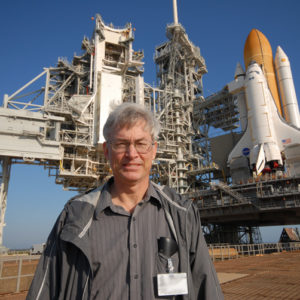
Enjoy our prelaunch and launch photos from the Space UpClose team of Ken Kremer and Jean Wright
“The primary payload on USSF-87 is the Geosynchronous Space Situational Awareness Program (GSSAP) space system,” said the Space Force in a press release.
“GSSAP is a space-based capability operating in a near-geosynchronous orbit supporting the U.S. Space Command space surveillance operations as dedicated Space Surveillance Network (SSN) sensors. The demonstration system is designed to test new technologies to enhance resiliency and protection for future programs of record.”
More from the Space Force:
The USSF-87 mission will carry a variety of payloads that will promote the advancement of space technology to benefit future programs of record. The primary payload is the Geosynchronous Space Situational Awareness Program (GSSAP) space system, built by Northrop Grumman; a capability supporting the U.S. Space Command space surveillance operations as a high-performance, dedicated Space Surveillance Network sensor. They provide ‘neighborhood watch’ services in the geostationary Earth arena, improving flight safety for all spacefaring nations operating in that orbit.
Enhanced positional knowledge of satellites within the increasingly crowded GEO drastically speeds USSF space operators’ ability to warn others if another object is anticipated to approach too closely or creates a hazardous situation. Data from the GSSAP will uniquely contribute to timely and accurate orbital predictions, enhancing our knowledge of the GEO environment and further enabling space flight safety, including satellite collision avoidance.
In addition to the GSSAP payload, USSF-87 will include additional research, development and training systems. Guardians will use these systems to refine tactics, techniques and procedures for precision on-orbit maneuvers. These systems will also enhance and validate resiliency and protection in geosynchronous orbit.
…………………
x