NASA’s Artemis II Space Launch System (SLS) rocket and Orion spacecraft rolled out from NASA’s Vehicle Assembly Building (VAB) atop NASA’s crawler-transporter 2 (CT-2) to Launch Complex 39B, on Saturday, Jan. 17, 2026, at NASA’s Kennedy Space Center in Florida. The crawler moves at a max speed of 0.82 mile for the 12-hour journey from VAB to pad 39B. Artemis II is a test flight to send 4 astronauts on a historic lunar flyby to the moon and back launching NET Early February 2026. Credit: Ken Kremer / Space UpClose
KENNEDY SPACE CENTER PRESS SITE, FL – NASA’s Artemis II SLS Orion rocket destined to carry the first humans to the Moon on a history making mission as soon as early February was rolled out to launchpad 39B on 17 Jan 2026 over 12 hours stretching from dawn to dusk
The rollout of the 11-million-pound Artemis II SLS/Orion rocket integrated stack from NASA’s VAB or Vehicle Assembly Building to launch Pad 39B at NASA’s Kennedy Space Center started with first motion at 7:04 a.m. EST using NASA’s crawler-transporter 2 and marks another major milestone on the path to launch.
UpClose with Orion crew capsule. NASA’s Artemis II Space Launch System (SLS) rocket and Orion spacecraft rolled out from NASA’s Vehicle Assembly Building (VAB) atop NASA’s crawler-transporter 2 (CT-2) to Launch Complex 39B, on Saturday, Jan. 17, 2026, at NASA’s Kennedy Space Center in Florida. The crawler moves at a max speed of 0.82 mile for the 12-hour journey from VAB to pad 39B. Artemis II is a test flight to send 4 astronauts on a historic lunar flyby to the moon and back launching NET Early February 2026. Credit: Ken Kremer / Space UpClose
The stack moved at almost one mile per hour (maximum speed of just 0.82 mph) along the four-mile route from the Vehicle Assembly Building to Launch Pad 39B, on a journey that will take up to 12 hours.
Water reflecting Artemis II. NASA’s Artemis II Space Launch System (SLS) rocket and Orion spacecraft rolled out from NASA’s Vehicle Assembly Building (VAB) atop NASA’s crawler-transporter 2 (CT-2) to Launch Complex 39B, on Saturday, Jan. 17, 2026, at NASA’s Kennedy Space Center in Florida. The crawler moves at a max speed of 0.82 mile for the 12-hour journey from VAB to pad 39B. Artemis II is a test flight to send 4 astronauts on a historic lunar flyby to the moon and back launching NET Early February 2026. Credit: Ken Kremer / Space UpClose
Enjoy our Artemis II rollout and briefing event photos taken at various spots along the way by the Space UpClose team of Ken Kremer and Jean Wright who attended the event as media
It took about an hour for the 11-million-pound Artemis II SLS/Orion rocket integrated stack to fully exit the VAB.
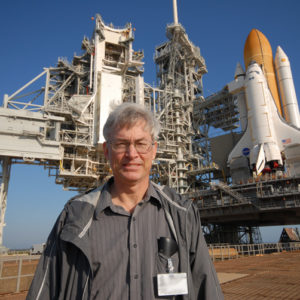
Jean Wright and Ken Kremer of Space UpClose pose with NASA Artemis II SLS Orion rocket stack during rollout from VAB to launch pad 39B on Jan. 17, 2026 at NASA’s Kennedy Space Center in Florida. Credit: Ken Kremer / Space UpClose
After moving a bit further the transporter paused for nearly an hour as the Crew Access Arm was unfurled from the rocket to the launch tower by the team.
“Once outside the VAB’s high-bay doors, the rocket made a planned pause allowing teams to reposition the crew access arm – a bridge that provides astronauts and a closeout crew access to Orion on launch day, said NASA.
NASA is targeting liftoff of the Artemis II mission with an international team of 4 astronauts from the US and Canada for no earlier then NET Feb. 6, 2026 from NASA’s Kennedy Space Center in Florida.
NASA’s Artemis II Space Launch System (SLS) rocket and Orion spacecraft rolled out from NASA’s Vehicle Assembly Building (VAB) atop NASA’s crawler-transporter 2 (CT-2) to Launch Complex 39B, on Saturday, Jan. 17, 2026, at NASA’s Kennedy Space Center in Florida. The crawler moves at a max speed of 0.82 mile for the 12-hour journey from VAB to pad 39B. Artemis II is a test flight to send 4 astronauts on a historic lunar flyby to the moon and back launching NET Early February 2026. Credit: Ken Kremer / Space UpClose
Their 10-day mission entails a lunar flyby around the Moon and back carrying humans further into deep space away from Earth than ever before
The Artemis II crew will soar about 4500 miles (7500 km) beyond the moon at its most distant point on the far side during the figure 8 or free return trajectory
Artemis II mission trajectory. Artemis II will be the first flight with crew aboard NASA’s deep space exploration system: the Orion spacecraft, Space Launch System (SLS) rocket and the ground systems at Kennedy Space Center in Cape Canaveral, Florida. During their mission, four astronauts will confirm all of the spacecraft’s systems operate as designed with people aboard in the actual environment of deep space, over the course of about a 10-day mission. The Artemis II flight test will pave the way to land the first woman and next man on the Moon on Artemis III. Credit: NASA
Artemis II counts as the first mission to the Moon by humans in over 50 years since NASA’s Apollo 17 lunar landing mission conducted in December 1972
NASA’s Artemis II Space Launch System (SLS) rocket and Orion spacecraft rolled out from NASA’s Vehicle Assembly Building (VAB) atop NASA’s crawler-transporter 2 (CT-2) to Launch Complex 39B, on Saturday, Jan. 17, 2026, at NASA’s Kennedy Space Center in Florida. Artemis II is a test flight to send 4 astronauts on a historic lunar flyby to the moon and back launching NET Early February 2026. Credit: Jean Wright / Space UpClose
The historic flight will carry four astronauts on a 10-day lunar flyby to the moon’s far side, preparing for humans to eventually return to the moon on Artemis III.
NASA’s Artemis II Space Launch System (SLS) rocket and Orion spacecraft rolled out from NASA’s Vehicle Assembly Building (VAB) atop NASA’s crawler-transporter 2 (CT-2) to Launch Complex 39B, on Saturday, Jan. 17, 2026, at NASA’s Kennedy Space Center in Florida. Artemis II is a test flight to send 4 astronauts on a historic lunar flyby to the moon and back launching NET Early February 2026. Credit: Jean Wright / Space UpClose
The Artemis II crew comprises Commander Reid Wiseman, Pilot Victor Glover, and Mission Specialist Christina Koch of NASA, along with CSA’s (Canadian Space Agency) Mission Specialist Jeremy Hansen
NASA Artemis II crew pose with their NASA Artemis II rocket during SLS/Orion rollout to launch pad 39b at NASA’s Kennedy Space Center in Florida – after media briefing at Countdown Clock, Jan 17, 2026. NASA astronauts Reid Wiseman, Victor Glover, Christina Koch & Canadian Space Agency astronaut Jeremy Hansen. Artemis II is a test flight to send 4 astronauts on a lunar flyby to the moon and back launching NET Early February 2026. Credit: Ken Kremer / Space UpClose
The Artemis II crew participated in a media briefing event at 9 a.m. ET during the rocket rollout.
Ken Kremer of Space UpClose posed a question about science they will be conducting during the 10-day mission. I asked the 3rd question – which is seen at the 18-minute mark in this NASA video:
Caption: NASA’s Artemis II Crew Rollout Media Event. Streamed live on Jan 17, 2026. NASA Administrator Jared Isaacman and the crew of Artemis II (NASA astronauts Reid Wiseman, Victor Glover, and Christina Koch; Canadian Space Agency astronaut Jeremy Hansen) are at NASA’s Kennedy Space Center to answer questions from the media about the upcoming mission and preparations. Through Artemis, NASA will send astronauts to explore the Moon for scientific discovery, economic benefits, and to build the foundation for the first crewed missions to Mars. Credit: NASA
Caption: Ken Kremer of Space UpClose Live Interview on Sky News About NASA Artemis II rocket rollout to launchpad on 17 Jan 2026. Interview at NASA’s Kennedy Space Center, Florida. Artemis II liftoff targeting early Feb 2026 from NASA’s Kennedy Space Center
In the coming days, NASA engineers and technicians will complete final preparations of the rocket.
They will prepare the Artemis II rocket for the wet dress rehearsal WDR, a test of fueling the cryogenic fuels liquid oxygen (LOX) and liquid hydrogen (LH2) into the core stage and upper stage with over 700,000 gallons of propellants
Crew Access Arm swing. NASA’s Artemis II Space Launch System (SLS) rocket and Orion spacecraft rolled out from NASA’s Vehicle Assembly Building (VAB) atop NASA’s crawler-transporter 2 (CT-2) to Launch Complex 39B, on Saturday, Jan. 17, 2026, at NASA’s Kennedy Space Center in Florida. Artemis II is a test flight to send 4 astronauts on a historic lunar flyby to the moon and back launching NET Early February 2026. Credit: Ken Kremer / Space UpClose
The launch and operations team will practice operations and countdown procedures by conduct a launch countdown with holds and recycles, and practice safely removing propellant from the rocket without astronauts onsite.
NASA’s Artemis II Space Launch System (SLS) rocket and Orion spacecraft rolled out from NASA’s Vehicle Assembly Building (VAB) atop NASA’s crawler-transporter 2 (CT-2) to Launch Complex 39B, on Saturday, Jan. 17, 2026, at NASA’s Kennedy Space Center in Florida. Artemis II is a test flight to send 4 astronauts on a historic lunar flyby to the moon and back launching NET Early February 2026. Credit: Ken Kremer / Space UpClose
“Targeted for no later than Feb. 2, the team will load the rocket with cryogenic, or super-cold, propellants, run through the countdown, and practice safely draining the propellants from the rocket – all essential steps before the first crewed Artemis mission.”
NASA emphasized that additional wet dress rehearsals may be required to ensure the vehicle is completely checked out and ready for flight.
If needed, NASA may rollback SLS and Orion to the Vehicle Assembly Building for additional work ahead of launch after the wet dress rehearsal.
NASA’s Artemis II Space Launch System (SLS) rocket and Orion spacecraft rolled out from NASA’s Vehicle Assembly Building (VAB) atop NASA’s crawler-transporter 2 (CT-2) to Launch Complex 39B, on Saturday, Jan. 17, 2026, at NASA’s Kennedy Space Center in Florida. The crawler moves at a max speed of 0.82 mile for the 12-hour journey from VAB to pad 39B. Artemis II is a test flight to send 4 astronauts on a historic lunar flyby to the moon and back launching NET Early February 2026. Credit: Ken Kremer / Space UpClose
“While the Artemis II launch window opens as early as Friday, Feb. 6, the mission management team will assess flight readiness after the wet dress rehearsal across the spacecraft, launch infrastructure, and the crew and operations teams before selecting a launch date,” says NASA.
NASA’s Artemis II Space Launch System (SLS) rocket and Orion spacecraft rolled out from NASA’s Vehicle Assembly Building (VAB) atop NASA’s crawler-transporter 2 (CT-2) to Launch Complex 39B, on Saturday, Jan. 17, 2026, at NASA’s Kennedy Space Center in Florida. Artemis II is a test flight to send 4 astronauts on a historic lunar flyby to the moon and back launching NET Early February 2026. Credit: Ken Kremer / Space UpClose
For Artemis 1 it took over 8 months from the time of first rollout in March 2022 until launch in Nov 2021 – due to technical issues, hydrogen leaks, two scrubs and poor weather including hurricanes.
NASA’s Artemis II Space Launch System (SLS) rocket and Orion spacecraft rolled out from NASA’s Vehicle Assembly Building (VAB) atop NASA’s crawler-transporter 2 (CT-2) to Launch Complex 39B, on Saturday, Jan. 17, 2026, at NASA’s Kennedy Space Center in Florida. Artemis II is a test flight to send 4 astronauts on a historic lunar flyby to the moon and back launching NET Early February 2026. Credit: Ken Kremer / Space UpClose
Ken Kremer recent TV interviews
Jan 17 Sky News at KSC press site as Artemis II rollout was underway
Ken Kremer of Space UpClose Live Interview on Sky News About NASA Artemis II rocket rollout to launchpad on 17 Jan 2026. Interview at NASA’s Kennedy Space Center, Florida. Artemis II liftoff targeting early Feb 2026 from NASA’s Kennedy Space Center. Video: https://youtu.be/U2ybAVZmVLM
Jan 15 Fox 35 Orlando: I’m Interviewed live about the successful return of crew 11 after the medical evacuation from the ISS. And what’s next for NASA and the crew and Artemis II. At Space View Park, Titusville
Jan 14: WESH 2 NBC News Orlando My complete live interview – With my analysis and commentary about NASA Crew-11 undocking from ISS this afternoon Jan 14 for early return to Earth with an ailing astronaut & NASA Artemis II moon launch status update with rocket rollout to pad 39B Jan 17 and launch NET Feb 6. Also -whats ahead with Artemis III moon landing far behind schedule since SpaceX moon lander years behind schedule – challenges for the new NASA Administrator Jared Isaacman:
Dr. Ken Kremer, Space UpClose, was interviewed live on WESH 2 NBC News Orlando on Jan 14, 2026. NASA is currently navigating a busy period with several significant projects, including the Crew 11 mission, the Artemis II project, and the introduction of a new administrator, prompting discussions with experts for insights. Dr. Ken Kremer, a research chemist, joined the conversation to provide context on these developments. Video link: https://www.wesh.com/article/nasa-major-projects-new-leadership/70004483
Jan 13 Fox 35 Orlando: Crew 11 update
Jan 8 Fox 35 Orlando: Here is my complete live interview by FOX 35 Orlando anchor Garret Wymer that’s was recorded at 1 p.m. Thursday, Jan. 8 – about the ailing crew 11 astronaut on board the International Space Station.
Caption: Spacewalk canceled, Crew 11 could come home early – NASA has postponed its first ISS spacewalk of the year, citing medical concerns for one of its crew members. NASA astronauts planned two spacewalks in January to conduct repairs and upgrades to the International Space Station. Ken Kremer, managing editor of Space UpClose, spoke with FOX 35’s Garrett Wymer about the latest on Jan 8, 2026
Caption: Ken Kremer of Space UpClose Live Interview on Sky News About NASA Artemis II rocket rollout to launchpad on 17 Jan 2026. Interview at NASA’s Kennedy Space Center, Florida. Artemis II liftoff targeting early Feb 2026 from NASA’s Kennedy Space Center. Video: https://youtu.be/U2ybAVZmVLM
x
Ken Kremer of Space UpClose asks 3rd question at Artemis II rollout and astronaut media briefing on Jan. 17, 2026 with the crew & new NASA Administrator Jared Isaacman at the Countdown Clock at NASA’s Kennedy Space Center in Florida. Since I’m a cancer/pharmaceutical researcher I asked about the science experiments the 4-person crew will run – and how it will benefit patients and research on Earth and sending humans to Mars. Christina Koch said “Great question” – and answered elegantly in great detail !! Credit: Jean Wright / Space UpClose
Watch for Ken’s continuing onsite coverage of NASA, SpaceX, ULA, Boeing, Lockheed Martin, Northrop Grumman and more space and mission reports direct from Kennedy Space Center and Cape Canaveral Air Force Station in Florida and Wallops Flight Facility in Virginia. Stay tuned here for Ken's continuing Earth and Planetary science and human spaceflight news. Dr. Kremer is a research scientist and journalist based in the KSC area, active in outreach and interviewed regularly on TV and radio about space topics. Ken’s photos are for sale and he is available for lectures and outreach events.
CAPE CANAVERAL, FL – I was interviewed live by WESH 2 NBC News Orlando on Mar 12 for my comments and analysis update follow todays NASA News Conference at the Kennedy Space Center Press Site NASA top managers announced that the Artemis II moon rocket repairs ti the Helium flow interruption are mostly complete inside the VAB and that the
TITUSVILLE, FL – Early risers lucky enough to gaze skyward witnessed a dazzling ‘Space Jellyfish’ illuminating the pre-dawn skies with stunning pastel colors flowing overhead following a SpaceX Falcon 9 launch of another batch of Starlink satellites from Florida’s Space Coast. Following liftoff of the SpaceX Falcon 9 at 5:52 a.m. ET on March 4, on the Starlink 10-40 mission