

KENNEDY SPACE CENTER, FL – At a news conference at the Kennedy Space Center press site held on February 27, 2026, NASA Administrator Jared Isaacman announced sweeping changes to Project Artemis – increasing the flight cadence for the SLS and Orion moon rocket by adding another test flight to improve resiliency and reliability, as well as changing the goals of future missions.
Artemis III will have a different goal, while NASA is changing the mission order to insert the additional hardware test flight.
“This is just not the right pathway forward,” Isaacman said at the briefing. “Going right to the moon … is not a pathway to success.”
Artemis III will now be conducted similar to Apollo 9 – a test flight to rendezvous and dock with a commercial human lunar lander in Earth orbit – from either SpaceX and/or Blue Origin in mid to late 2027, whichever is ready for rendezvous and docking with the Orion crew capsule.
Ideally both would be available during the same Orion test flight with a crew of astronauts yet to be named.
Lunar landers supplied by Blue Origin and/or SpaceX will not take crews to the Moon’s surface until Artemis IV and V in 2028 and beyond.
“NASA must standardize its approach, increase flight rate safely, and execute on the President’s national space policy. With credible competition from our greatest geopolitical adversary increasing by the day, we need to move faster, eliminate delays, and achieve our objectives,” said NASA Administrator Jared Isaacman.
“Standardizing vehicle configuration, increasing flight rate and progressing through objectives in a logical, phased approach, is how we achieved the near-impossible in 1969 and it is how we will do it again.”
Isaacman hopes to increase the Artemis SLS Orion flight rate to at least once per year vs a single launch every 3.5 years as is currently – so that teams stay focused, active, primed and ready, and so that learned skills don’t atrophy.
By launching annually, NASA hopes to rebuild core competencies in the civil servant workforce including more in-house and side-by-side development work with the agency’s Artemis partners, enabling a safer, more reliable, and faster launch cadence.
Isaacman is instituting a step by step approach to enhance safety and buy down risk just as NASA did in the 1960s
“We did not just jump right to Apollo 11. We did it through Mercury, Gemini and lots of Apollo missions with the launch cadence every three months,” Isaacman said.
“We shouldn’t be comfortable with the current cadence. We should be getting back to basics and doing what we know works.”
SLS and Orion will be standardized into a near Block 1 configuration so that each is not a “work of art” as Isaacman stated to make them more reliable and robust.
NASA will forgo improvements to Block 1B and Block 2 configuration and is apparently cancelling the much more powerful Boeing EUS or Exploration upper stage – at last for now.
“After successful completion of the Artemis I flight test, the upcoming Artemis II flight test, and the new, more robust test approach to Artemis III, it is needlessly complicated to alter the configuration of the SLS and Orion stack to undertake subsequent Artemis missions,” said NASA Associate Administrator Amit Kshatriya.
“There is too much learning left on the table and too much development and production risk in front of us. Instead, we want to keep testing like we fly and have flown. We are looking back to the wisdom of the folks that designed Apollo. Therefore, we want to fly the landing missions in as close to the same Earth ascent configuration as possible – this means using an upper stage and pad systems in as close to the ‘Block 1’ configuration as possible.”
The once-planned Gateway which was slated to be the first space station orbiting the Moon, seems to be on hold for now to focus on the lunar landings and to establish a lunar base.
I asked about the Gateway’s fate and future at the briefing.
Here is Isaacman’s response.
“By focusing a lot of time, energy and resources across lots of grand endeavors is why you end up in a situation where you’re launching incredibly important but complex vehicle every three-plus years,” Isaacman replied to Space UpClose.
“I say that not to make a statement towards Gateway because we are doing this to get back to the Moon and have the capability to stay, certainly to build a moonbase.”
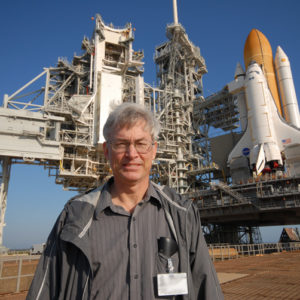
The Space UpClose team of Ken Kremer and Jean Wright both attended the News conference dealing with changes to Artemis missions and an update on Artemis II repairs following rollback into the VAB – and we both asked questions
Here is the NASA News Conference video streamed live on Feb 27, 2026:
https://www.youtube.com/live/eCbQtyUopOM?si=CjmHd3wprqfq6OKa
Following the rollback of the Artemis II SLS (Space Launch System) rocket and Orion spacecraft on Wednesday, Feb. 25, experts will discuss the work ahead for the Artemis II test flight around the Moon and provide broader updates on the Artemis campaign. NASA participants include:
- Administrator Jared Isaacman
- Associate Administrator Amit Kshatriya
- Lori Glaze, acting associate administrator for NASA’s Exploration Systems Development Mission Directorate
Following the news conference Ken Kremer of Space UpClose was asked to do a live interview on FOX 35 Orlando about the Artemis major overhaul changes announced by Isaacman.
Watch my complete live interview video here:
https://www.fox35orlando.com/video/fmc-a6ek0hlgtbyfoazh
Caption: NASA announces major overhaul of lunar mission plans. NASA held a news conference Friday Feb. 27, 2026, where administrator Jared Isaacman announced significant changes to the agency’s Artemis II program. FOX 35’s Garrett Wymer spoke with Ken Kremer, Managing Editor of Space UpClose, about what was discussed.
Ken Kremer recent TV interviews about Artemis:
Fox 35 Orlando video: https://www.fox35orlando.com/video/fmc-a6ek0hlgtbyfoazh
NBC Orlando video: https://www.wesh.com/article/nasa-moves-artemis-ii-off-launch-pad-for-more-repairs/70503151
ABC Orlando Video: https://www.wftv.com/news/nasa-rolls-back-artemis-ii-rocket-repairs-launch-april-tentative/1c297ed0-720f-4487-a163-fc87b4d3f7b9/
x