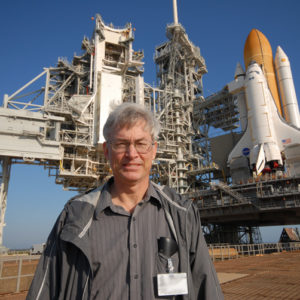


KENNEDY SPACE CENTER/CAPE CANAVERAL, FL – As part of the ongoing investigation into why significant levels of gaseous hydrogen were detected during the recent WDR wet dress rehearsal cryogenic propellant loading test on Feb. 2 – that forced NASA to abort the final steps of the test – the agency conducted an unannounced liquid hydrogen (LH2) partial fueling test of the NASA Artemis II core stage today Feb. 12 dubbed a ‘confidence test.’
NASA engineers and the launch team conducted the ‘Confidence Test’ in order to gain a better understanding of the serious hydrogen gas leaking problems, and their source, after replacing seals in the TSMU (Tail service mast umbilical) on top of pad 39B (see my photo showing the TSMU), I confirmed with NASA officials.
The extent of the unannounced LH2 prop load today is not known.
Excess gaseous Hydrogen leaking above allowable concentration limits (16%) is extremely dangerous and flammable and could result in a fire and violent explosion.
The Feb. 2 WDR test was terminated early when the hydrogen gas level reached 16% at the T Minus 5 minute point in the terminal countdown
“As part of our work to assess the repair we made in the area where we saw elevated hydrogen gas concentrations during the previous wet dress rehearsal, engineers are testing the new seals by running some liquid hydrogen across the interface and partially filling the core stage liquid hydrogen tank. The data will inform the timeline for our next wet dress rehearsal” – NASA told Space UpClose
The launch team was eventually able to fully fuel the Artemis II rocket to 100% levels for both LH2 and LOX in both the core and upper stages with over 700,000 gal propellants during the Feb. 2 WDR after several interruptions and pauses – by slowing or stopping the fueling flow and allowing the seals to seat fully and properly during the fueling countdown process.
Much valuable data was collected during the WDR
Teams dismantled the ground and rocket sides of the TSMU interface plate after the WDR to gain a better understanding of the issues and also replaced the leaking hydrogen seals in the 4 inch and 8 inch propellant loading lines – as well as they conducted further testing to understand the physics and dynamics of the system at NASA Stennis, Miss.
Depending on the outcome of the LH2 confidence filling test, NASA will decide when to conduct the next complete WDR test – possibly as soon as next week.
NASA says a new launch date will not be announced until a successful WDR is completed.
The next launch period opens in early March
Because of the test campaign today, public tours by KSCVC around launch pad 39B were suspended for the day for safety reasons.
Update Feb 13:
After the conclusion of the Feb. 12 Confidence NASA provided SpaceUpClose with an update on Feb. 13saying LH2 tank was filled to less than 5 percent and further analysis is needed on the way forward with testing
“The liquid hydrogen tank was filled to less than 5 percent.
NASA engineers continue to perform assessments and analysis following the first wet dress rehearsal in advance of Artemis II. As part of the efforts to ensure leakage is remediated the teams implemented a confidence test that included partially filling the core stage of the SLS (Space Launch System) with liquid hydrogen. As teams were moving into fast fill operations with liquid hydrogen on Thursday they encountered a ground equipment issue and decided to end the test.
We are evaluating our path forward and will share more details on next steps soon.”
Ken Kremer recent TV interviews:
Feb 19 WKMG CBS News Orlando: https://www.clickorlando.com/news/space-news/2026/02/18/nasa-astronauts-watch-on-as-crucial-artemis-ii-testing-wraps-up/
x