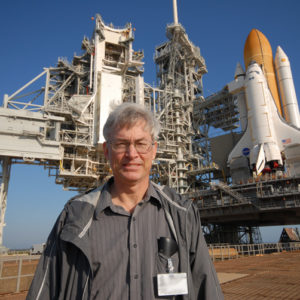


TITUSVILLE, FL – On July 3, I was interviewed on two TV networks on FOX 35 Orlando and WESH NBC News Orlando about the successful launch of NASAs first-of-its-kind satellite robotic servicing rescue mission to save NASAs $500 million Swift space telescope which is quickly falling from orbit.
See story & video links below
Its High Risk, High Reward and High Excitement!!! – all rolled into one bold and historic mission – that began only 9 months ago when NASA awarded a $30 million contract to Katalyst Space in September 2025
NASAs Swift space telescope is in desperate need of reboost since its falling to Earth.
It was not designed for capture, reboost or refueling. So this is all experimental
NASA’s rescue plan involves using a new robotic spacecraft named LINK – that was air launched on a Pegasus rocket – that will grapple the probe and rescue it by raising its orbit as soon as possible which is decaying due to atmospheric drag
The Swift boost mission to raise the altitude of NASA’s Neil Gehrels Swift Observatory is underway after launching LINK on a Northrop Grumman- built Pegasus XL rocket at 8:36 p.m. Marshall Islands Time (4:36 a.m. EDT), Friday, July 3, from Kwajalein Atoll in the South Pacific Ocean.
High solar activity has created more atmospheric drag than expected and is causing the orbit of the over 20-year old but still very productive NASA Swift space observatory to degrade more rapidly than expected.
Watch the Fox 35 Orlando story with my comments about the Swift rescue mission and how I demonstrate how LINK will grapple Swift – here:
Fox 35 features 3 of my photos from 2 prior NASA science mission launches on the Pegasus XL rocket – and included here:
Caption: A first-of-its-kind mission to rescue a failing satellite is underway after a rocket carrying a spacecraft designed to capture and reposition the satellite successfully launched Friday morning. Dr. Ken Kremer, research chemist with Space UpClose joins Esther Bower of Fox 35 Orlando on July 3, 2026 to discuss the Swift boost mission which successfully launched on a Pegasus XL rocket on July 3, 2026. Credit: Fox 35 Orlando/Ken Kremer/SpaceUpClose.com
Watch the WESH 2 NBC News story with my comments about the Swift rescue mission here:
https://www.wesh.com/article/nasa-swift-observatory-rescue-mission/71819694
Read my story from 2019 about two prior NASA science mission launches on the Pegasus XL rocket including numerous photos from me. Several my photos included in the new Fox 35 interview:
https://kenkremer.blogspot.com/2019/10/up-close-with-nasa-icon-pegasus-rocket.html
This also counts as the final flight of the Pegasus XL rocket since the first flight in 1990
Whether this quickly developed and risky satellite mission succeeds or not there are many valuable lessons learned and many future applications.
Time is of the essence and there is no time to waste
LINK must reach Swift before it drops in altitude to below roughly 186 miles (300 km) – and the mission would be unlikely to succeed due to instability of Swift in its orbit
Following several days of weather and technical delays conditions were finally just right on July 3 and the last planned Pegasus XL rocket mission was airdropped from the belly of the last remaining Northrop Grumman L-1011 Stargazer carrier aircraft at an altitude of about 40,000 feet
All 3 solid fueled staged fired as planned and the LINK spacecraft successfully reached orbit, NASA reported.
LINK achieved an orbit of about 362 x 392 km x 20.6 deg inclination.
The solar arrays were deployed as planned and LINK is power positive.
LINK will take a few weeks to catch up to Swift as teams check out the spacecraft systems and then target it for an upclose rendezvous
“Teams have successfully established communications with Katalyst Space’s robotic servicing spacecraft LINK,” NASA said
“Making contact with LINK was the spacecraft’s first in-orbit operation, after launch and separation Friday from Northrop Grumman’s Pegasus XL rocket and power-on.”
“Over the next several weeks, Katalyst will perform checkout procedures for LINK, including assessments of its propulsion, sensor, and navigation systems.”
Teams will then use some time to photograph and inspect Swift to determine the best grapple locations
Since Swift has the ability to maintain its attitude that capability should aid the grappling link up of LINK with Swift
The actual reboost of Swift will then require several more months as LINK slowly pushes Swift to a high orbit
The 3-stage solid fueled propulsion Pegasus XL basically functions as a cruise missile for science for deploying small, lightweight satellites to low Earth orbit (LEO) – in this instance for NASA.
After dropping horizontally for a 5 second free-fall, the first stage of the Pegasus ignites.
The other 2 stages then fire in succession and the payload reached orbit in about 11 minutes or so.
The boost and grapple technology developed by the LINK spacecraft builder, Katalyst Space, has potentially broad applications to use on other aging and malfunctioning satellites that could demonstrate a new way to extend the operational lives of satellites for NASA, the military and commercial and science satellites.
NASA is spending $30 million to capture the aging space telescope and push it into a safer and productive orbit and extend its lifetime by 5 to 10 years or more.
More from NASA
The Swift mission, which launched in 2004, leads NASA’s fleet of telescopes in studying changes in the high-energy universe, like gamma-ray bursts, which are the most powerful explosions in the cosmos. When a rapid, sudden event takes place in the sky, Swift serves as a “dispatcher,” providing critical information that allows other “first responder” missions to follow up to learn more about how the universe works.
After 21 years, Swift’s low Earth orbit has begun to rapidly decay because of increased solar activity. Rather than allowing the observatory to re-enter Earth’s atmosphere, as many missions do at the end of their lifetimes, NASA is using this opportunity to advance U.S. spacecraft servicing technology.
In September 2025, NASA awarded a contract to Katalyst to mount a robotic servicing mission for Swift in less than a year. The mission will use LINK to rendezvous with Swift and boost it to a higher altitude, demonstrating a key capability for the future of space exploration. The mission is targeted for launch in June from Kwajalein Atoll, Marshall Islands.
x