
Last Launch Looming for Most Powerful ULA Atlas V Rocket Configuration Nicknamed ‘The Bruiser’ on Leo 8 Mission: Pad Photos

Last launch looms for ULA Atlas V rocket mightiest version in 551 configuration as it stands vertical at Space Launch Complex-41 at Cape Canaveral Space Force Station in Florida. Photograph by Ken Kremer of Space UpClose is featured on the WFTV ABC News Orlando evening news program on July 1, 2026. Liftoff target July 2 at 12:24 a.m. EDT. Screenshot Credit: Ken Kremer/SpaceUpClose.com/ WFTV ABC News Orlando

CAPE CANAVERAL SPACE FORCE STATION, FL –  The last launch is looming for the most powerful version of the United Launch Alliance (ULA) Atlas V rocket nicknamed ‘The Bruiser’ – as it sits poised for liftoff from Florida’s Space Coast just past midnight early Thursday morning July 2 carrying another batch of satellites for Amazons Leo operational broadband constellation of commercial internet comsats to orbit.

The 205 ft tall (62.5 m) ULA Atlas V rocket assembled into the 551 configuration stands vertical at Space Launch Complex-41 at Cape Canaveral Space Force Station.

Last launch looms for ULA Atlas V rocket mightiest version in 551 configuration as it stands vertical at Space Launch Complex-41 at Cape Canaveral Space Force Station in Florida. Liftoff target July 2 at 12:24 a.m. EDT. Credit: Ken Kremer/SpaceUpClose.com

The launch is named ULA Atlas V Leo 8 – also referred to as Leo Atlas 8 (LA-08) by Amazon.

The nosecone and is packed with a heavy payload of 29 Amazon Leo broadband internet satellites

Enjoy our photos taken by Ken Kremer and Jean Wright taken for Space UpClose directly at pad 41 this afternoon July 1.

Last launch looms for ULA Atlas V rocket mightiest version in 551 configuration as it stands vertical at Space Launch Complex-41 at Cape Canaveral Space Force Station in Florida. Liftoff target July 2 at 12:24 a.m. EDT. Credit: Jean Wright/SpaceUpClose.com

The lead photo by Ken Kremer was featured this evening, July 1, on WFTV ABC News Orlando for a mission story.

The Atlas V was rolled out to pad 41 atop the MLP and lowered ‘hard down’ onto the launch pad at 11:11 a.m. EDT (1511 UTC), per ULA – just prior to our media event setting up remote cameras.

Last launch looms for ULA Atlas V rocket mightiest version in 551 configuration as it stands vertical at Space Launch Complex-41 at Cape Canaveral Space Force Station in Florida. Liftoff target July 2 at 12:24 a.m. EDT. Credit: Ken Kremer/SpaceUpClose.com

Liftoff is planned on Thursday, July 2, from Space Launch Complex-41 at Cape Canaveral Space Force Station in Florida at 12:24 a.m. EDT with a 29-minute window.

The rocket will fly on a northeasterly trajectory

Today’s forecast shows an 85 percent chance of favorable weather conditions for launch.

Launch visibility chart. ULA

Overall the payloads weighs 18000 lbs, matching the heaviest to date for an Atlas V

This marks the 110th Atlas 5 rocket launched to date since its debut in 2002.

Last launch looms for ULA Atlas V rocket mightiest version in 551 configuration as it stands vertical at Space Launch Complex-41 at Cape Canaveral Space Force Station in Florida.  Liftoff target July 2 at 12:24 a.m. EDT. Credit: Ken Kremer/SpaceUpClose.com

Amazon aims for an initial constellation of over 3200 satellites to compete with SpaceX Starlink

This will be the final Amazon Leo mission on the Atlas V rocket and the last in the most powerful 551 configuration .

Last launch looms for ULA Atlas V rocket mightiest version in 551 configuration as it stands vertical at Space Launch Complex-41 at Cape Canaveral Space Force Station in Florida. Liftoff target July 2 at 12:24 a.m. EDT. Credit: Jean Wright
/SpaceUpClose.com

The remaining 6 Atlas Vs are dedicated to Boeing Starliner missions. They will fly in the N22 configuration

Overall this brings the total of Amazon Leo broadband satellites launched to 396

Last launch looms for ULA Atlas V rocket mightiest version in 551 configuration as it stands vertical at Space Launch Complex-41 at Cape Canaveral Space Force Station in Florida. Liftoff target July 2 at 12:24 a.m. EDT. Credit: Ken Kremer/SpaceUpClose.com

The LEO satellites are manufactured in Kirkland, Washington, then flown to an  Amazon satellite processing facility at NASA’s Kennedy Space Center in Florida

Amazon is using a variety of launch providers to send Leo to orbit.  In addition to ULA this includes Arianespace Ariane 6 and SpaceX Falcon 9 rockets

Last launch looms for ULA Atlas V rocket mightiest version in 551 configuration as it stands vertical at Space Launch Complex-41 at Cape Canaveral Space Force Station in Florida. Liftoff target July 2 at 12:24 a.m. EDT. Credit: Ken Kremer/SpaceUpClose.com

This sets up a new broadband internet system for direct head-to-head competition with the already well-established SpaceX Starlink satellite system – comprising some 10000 orbiting satellites in LEO.

ULA launches the Leo sats to an altitude of approx. 290 miles (465 kilometers)

After checkout they will be raised to their assigned orbit of 392 miles (630 km) altitude above Earth.

Last launch looms for ULA Atlas V rocket mightiest version in 551 configuration as it stands vertical at Space Launch Complex-41 at Cape Canaveral Space Force Station in Florida. Photograph by Ken Kremer of Space UpClose is featured on the WFTV ABC News Orlando evening news program on July 1, 2026. Liftoff target July 2 at 12:24 a.m. EDT. Screenshot Credit: Ken Kremer/SpaceUpClose.com/ WFTV ABC News Orlando

More about ULA Atlas V Centaur

The Amazon-built Kuiper spacecraft are encapsulated in a 17.7-ft (5.4-m) diameter medium payload fairing (PLF).

The PLF is a sandwich composite structure made with a vented aluminum-honeycomb core and graphite-epoxy face sheets. The bisector (two-piece shell) PLF encapsulates both the Centaur and the satellites.

Last launch looms for ULA Atlas V rocket mightiest version in 551 configuration as it stands vertical at Space Launch Complex-41 at Cape Canaveral Space Force Station in Florida. Liftoff target July 2 at 12:24 a.m. EDT. Credit: Ken Kremer/SpaceUpClose.com

The Atlas V vehicle height with the 5-meter medium PLF is approximately 205 ft (62.5 m).

The Atlas V booster is 12.5 ft (3.8 m) in diameter and 106.5 ft (32.5 m) in length. The booster’s tanks are structurally rigid and constructed of isogrid aluminum barrels, spun-formed aluminum domes and intertank skirts.

Last launch looms for ULA Atlas V rocket mightiest version in 551 configuration as it stands vertical at Space Launch Complex-41 at Cape Canaveral Space Force Station in Florida. Liftoff target July 2 at 12:24 a.m. EDT. Credit: Jean Wright/SpaceUpClose.com

Booster propulsion is provided by the RD-180 engine system (a single engine with two thrust chambers). The RD-180 burns RP-1 (Rocket Propellant-1 or highly purified kerosene) and liquid oxygen and delivers 860,200 lbs (3.83 mega-Newtons) of thrust at sea level.

Five solid rocket boosters (SRBs) generate the additional power required at liftoff, with each providing 371,550 lbs (1.6 mega-Newtons) of thrust.

Last launch looms for ULA Atlas V rocket mightiest version in 551 configuration as it stands vertical at Space Launch Complex-41 at Cape Canaveral Space Force Station in Florida. Liftoff target July 2 at 12:24 a.m. EDT. Credit: Ken Kremer/SpaceUpClose.com

The Centaur avionics system, provides guidance, flight control and vehicle sequencing functions during the booster and Centaur phases of flight.

The Centaur second stage is 10 ft (3 m) in diameter and 41.5 ft (12.6 m) in length. Its propellant tanks are pressure-stabilized and constructed of corrosion-resistant stainless steel.

Centaur is a cryogenic vehicle, fueled with liquid hydrogen and liquid oxygen, powered by an RL10A-4-2 engine producing 22,600 lbs (100.5 kilo-Newtons) of thrust. The cryogenic tanks are insulated with a combination of helium-purged blankets, radiation shields and spray-on foam insulation (SOFI). The Centaur forward adapter (CFA) provides structural mountings for the fault-tolerant avionics system and structural and electrical interfaces with the spacecraft.

Ken Kremer and Jean Wright of Space UpClose pose with ULA Atlas V Leo rocket directly at pad 41 on July 1, 2026 for liftoff targeting July 2, 2026. Credit: Ken Kremer/SpaceUpClose.com


Ken Kremer and Jean Wright of Space UpClose pose with ULA Atlas V Leo rocket directly at pad 41 on July 1, 2026 for liftoff targeting July 2, 2026. Credit: Ken Kremer/SpaceUpClose.com


x

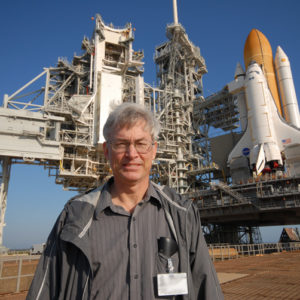
Ken Kremer

Watch for Ken’s continuing onsite coverage of NASA, SpaceX, ULA, Boeing, Lockheed Martin, Northrop Grumman and more space and mission reports direct from Kennedy Space Center and Cape Canaveral Air Force Station in Florida and Wallops Flight Facility in Virginia. Stay tuned here for Ken's continuing Earth and Planetary science and human spaceflight news. Dr. Kremer is a research scientist and journalist based in the KSC area, active in outreach and interviewed regularly on TV and radio about space topics. Ken’s photos are for sale and he is available for lectures and outreach events.

Leave a Reply

Your email address will not be published. Required fields are marked *

This site uses Akismet to reduce spam. Learn how your comment data is processed.