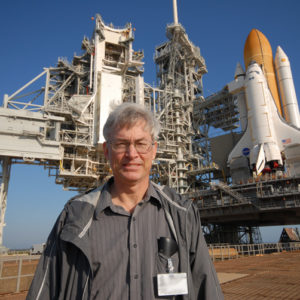


NASA KENNEDY SPACE CENTER – SHUTTLE LANDING FACILITY – NASA Administrator Jared Isaacman told me that he is “extremely confident” that NASA’s Artemis III mission will launch next year in 2027 where NASA’s Orion crewed spacecraft is scheduled to dock with both of the commercial human lunar landers being built by SpaceX and Blue Origin – under contract to NASA.
Isaacman responded to my question about the status of the both commercial human landers and whether they be ready for liftoff in 2027 – during a media Q&A session at the Kennedy Space Center Shuttle Landing Facility (SLF) where he announced the new MAX Power aerospace event show to be held Nov. 7-8 at NASA’s Kennedy Space Center in Florida.
Watch the entire briefing here: Ken Kremer question at 33 min mark
Watch the Q&A only portion here: Ken Kremer question at 6 min mark
Here’s a transcript of Ken Kremer of Space UpClose question to NASA Administrator Jared Isaacman
“You mentioned Artemis III a couple of times. Can you Jared, please give us an update, please, where do these pathfinder [human landers] stand from both Blue Origin and SpaceX?” Ken Kremer of Space UpClose asked NASA Administrator Jared Isaacman at the NASA MAX Power Expoe event on Aug. 14.
“Will you be able to launch next year? And what kind of Artemis exhibits will you have at the MAX Power airshow.”
Isaacmans response:
“I’m extremely confident that we are we are going to be able to launch Artemis III next year. That’s why we stepped into stacking operations,” Isaacman said.
He was describing the currently ongoing stacking and assembly operations for the Space Launch System (SLS) rocket taking place inside the Vehicle Assembly Building (VAB) at the Kennedy Space Center (KSC).
“I had a chance to visit with the Blue Origin team earlier, walked the assembly line floor today, looking at components that will make their way into the Blue Origin test lander that we will be rendezvousing and docking with,” Isaacman added.
“And I’ll tell you, if you spoke to Blue Origin, they would say the same thing. What we are going to learn from that mission, the amount of risk we’re going to be able to bring down in advance of Artemis IV will be significant.”
“So much so that I think in fact, if you coupled that with the uncrewed landing demonstration, you’d be very confident in what they’re going to be able to achieve potentially in 2028. So they’re moving very quickly.”
“I tell you we manage the schedule down to the day collectively. Every single component of the Artemis program we manage down to the day, and down to the hour.”
“So from the enhancements to the SLS vehicle and Centaur to the Orion readiness on this to suit development to our two different landers, we are paying very close attention to. And we, as I’ve said many times, the talent across NASA is driving outcomes alongside our partners”
“Now with respect to SpaceX, I think what you’re witnessing, you’re seeing an increase in launch cadence, and that’s critical. If they’re able to launch again in early September after their last launch and continue to track inside of a month, potentially every couple of weeks before the end of the year, that’s going to — we’re going to feel very good about their time to contribute to Artemis III next year,” Isaacman amplified.
“They’ve already started cutting hardware for that test vehicle. We track that every single day, so that’s the test lander. So we’re feeling very good about that, and I’d say more so with each step along the way that you get better about Artemis III, you’re feeling that much better about Artemis IV and its timeline in ’28.”
I also asked what NASA would be contributing specifically for Artemis exhibits and displays to the air show that the public can see.
“I’d say first and foremost, you’re going to have the people here you know, the Artemis astronauts that have flown on their missions and that are getting ready to fly on the missions. And then you’re going to have the Apollo astronauts here that we’re learning so much from. So I start with the people because it’s probably one of the most exciting things.”
“You will see rovers. You’ll see landers from the CLIPS [Commercial Lunar Payload Services] programs here.”
“You’ll see a lot of hardware that either has applicability to the early Artemis missions – including very well you might get a great view of Artemis III [stack] on its way out to pad 39B. You’ll also see a lot of critical components of the Moon Base that we’re building as well,” Isaacman concluded.
The team of Ken Kremer and Jean Wright attended the event for Space UpClose
NASA is targeting liftoff of Artemis III sometime in the second half of 2027 of the SLS Orion stack into low Earth orbit (LEO).
NASA recently named the Artemis III crew comprising:
- NASA astronaut Randy Bresnik, commander
- ESA (European Space Agency) astronaut Luca Parmitano, pilot
- NASA astronaut Andre Douglas, mission specialist
- NASA astronaut Frank Rubio, mission specialist
Credit: NASA/Bill Stafford
Artemis III may be the most complicated mission and tightly scripted launch campaign NASA has ever attempted – and has an expected duration of roughly 2 weeks.
“During Artemis III, the agency’s SLS (Space Launch System) rocket will launch the Orion spacecraft and its crew from NASA’s Kennedy Space Center in Florida to low Earth orbit,” according to NASA.
“After Orion systems checkouts, the spacecraft will, for the first time, demonstrate rendezvous and docking capabilities with test versions from one, or both, American commercial human landing systems in development by Blue Origin and SpaceX.”
“This highly choreographed mission includes a dramatic multi-launch campaign of the world’s most powerful rockets, testing integrated hardware between Orion and the landers, including system interfaces, software, propulsion, and communications.”
The launch campaign involves the liftoffs of 3 heavy lift rockets within a space of roughly a month
Artemis III may be the most complicated mission and tightly scripted launch campaign NASA has ever attempted – and has an expected duration of roughly 2 weeks.
“During Artemis III, the agency’s SLS (Space Launch System) rocket will launch the Orion spacecraft and its crew from NASA’s Kennedy Space Center in Florida to low Earth orbit,” according to NASA.
“After Orion systems checkouts, the spacecraft will, for the first time, demonstrate rendezvous and docking capabilities with test versions from one, or both, American commercial human landing systems in development by Blue Origin and SpaceX.”
“This highly choreographed mission includes a dramatic multi-launch campaign of the world’s most powerful rockets, testing integrated hardware between Orion and the landers, including system interfaces, software, propulsion, and communications.”
The launch campaign involves the liftoffs of 3 heavy lift rockets within a space of roughly a month
The first launch involves launch of Blue Origin Blue Moon Mark 2 pathfinder test human lunar lander vehicle into low Earth orbit. The pathfinder lander is equipped with a docking port and pressurized crew cabin. The lander will be thoroughly checked out before
The next step is launch of Artemis III crew on SLS Orion. They will demonstrate rendezvous and docking capabilities and actually dock with Blue Moon Mk 2 test vehicle
They will open the hatch and enter the pressurized spacecraft and may also don and test the EVA moonwalking spacesuits prototype.
After undocking step 3 will commence.
Step 3 involves launch of SpaceX Super Heavy Starship combo.
The generic Starship will be outfitted with a simple docking ring. Orion will dock but there is no pressurized cabin. Thus the astronauts cannot enter.
Starship however will fire thrusters gently to test out the docked spacecraft configuration to evaluate command and control of the stack.
Artemis III crew will then undock and return to Earth via parachute assisted splashdown in the Pacific Ocean off the coast of California.
We reported on the arrival of the Artemis III core stage a few months ago on April 28
Credit: Ken Kremer / Spaceupclose.com
Ken Kremer has done interviews about the mission and the arrival
x