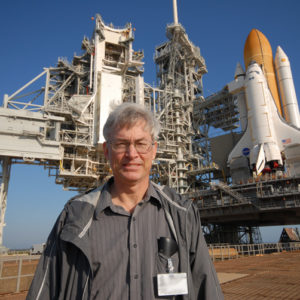


TITUSVILLE, FL – On July 10 I was interviewed on WFTV ABC News Orlando about NASA’s preparations to ready the agency’s new Wide-Field-View Roman Space Telescope for launch NET Aug 30 and about its science capabilities compared to the Hubble Space Telescope and James Webb Space Telescope
With less than two months until the launch of NASA’s Nancy Grace Roman Space Telescope, engineers at NASA’s Kennedy Space Center in Florida are preparing Roman for its trip to space aboard a SpaceX Falcon Heavy rocket as soon as Aug. 30.
NASA’s newest space observatory, the next generation Nancy Grace Roman Space Telescope arrived on Fathers Day, June 21, at the Turn Basin wharf at NASA’s Kennedy Space Center in Florida, cocooned safely inside NASA’s Pegasus barge.
Ken Kremer and Jean Wright of Space UpClose were on hand as members of the media invited by NASA to view the thrilling arrival events
Enjoy our photos taken by the team of Ken Kremer and Jean Wright
Roman is NASA’s newest space telescope and is getting closer to revealing the universe in a way never seen before.
The Nancy Grace Roman Space Telescope is undergoing final testing inside Kennedy Space Center’s Payload Hazardous Servicing Facility, where engineers are checking the spacecraft’s systems ahead of its planned launch later this summer.
Dr. Ken Kremer of Space UpClose says the space telescope will provide a much wider view of the cosmos than previous observatories like Hubble and the James Webb Space Telescope, in an interview on July 10 with WFTV ABC News Orlando.
“Hubble can look at like a finger time. This new telescope Roman can look at the size of a full Moon. So that field of view is like about 200 times wider. And its equipped with a 300 megapixel camera, much more powerful,” Kremer told WFTV.
Technicians have raised the observatory into its operating position, powered up the spacecraft, and are testing key components, including its thermal blankets and solar panels. “They’re going to check the solar panels to make sure that they flex, that they open up. Because that’s what has to happen,” Kremer said.
NASA/Sydney Rohde (Rocz)
Once in space, Roman’s powerful camera will capture vast regions of the universe in a single image, helping scientists search for planets beyond our solar system and study mysteries such as dark matter and dark energy.
Kremer says the space telescope could also help answer one of the biggest questions in astronomy: whether other worlds could potentially support life.
“That will help us find out not only the number of planets, the number of exoplanets distributed throughout the universe, but whether some of them might be habitable,” Kremer said.
Roman is NASAs next powerful space observatory – following in the footsteps of Hubble, Chandra, Swift, JWST and more.
The Roman Space Telescope offers wide field look at the universe in search of dark energy and exoplanets in infrared light – complementing JWST, the James Webb Space Telescope
Roman is named after NASA’s first chief astronomer – Nancy Grace Roman
Pegasus also recently ferried NASA’s Artemis III core stage to KSC from NASA Michoud Assembly Facility – see our earlier story
Inside the Payload Hazardous Servicing Facility, technicians used large cranes to carefully lift Roman and place it onto a specialized work platform, known as the Pantheon. This step transitions the observatory from its shipping configuration to the operational configuration necessary to begin integration and test activities that will prepare it for encapsulation and launch. Engineers then powered up the observatory to perform system checkouts, ensuring the telescope is operating correctly following its arrival at Kennedy.
Throughout the coming weeks, technicians plan to test Roman’s six solar array panels, inspect the space telescope’s insulation and thermal blankets, and test the spacecraft’s propellant tanks. Once those tests are complete, they will load approximately 290 gallons of hydrazine fuel into the observatory before encapsulating it inside a SpaceX payload fairing, one of the final steps before launch.
NASA is targeting no earlier than Sunday, Aug. 30, for the space observatory’s launch on a SpaceX Falcon Heavy rocket from Launch Complex 39A at Kennedy. The liftoff will occur about nine months ahead of schedule.
Roman will travel to the Sun-Earth Lagrange point 2, or L2, about one million miles from Earth, where the Sun’s and Earth’s gravity balance out. Orbiting at L2 will give the telescope a stable, unobstructed view of the universe and keep it far enough away so that Earth won’t block much of its view. From this vantage point, Roman will help answer questions about dark matter, dark energy, and exoplanets.
Roman’s wide field of view and rapid survey capabilities will map billions of galaxies, discover new exoplanets, study black holes, and provide vast volumes of daily data for astronomers to analyze. The observatory will sample such a large volume of the cosmos that the mission will offer practically limitless opportunities for astronomers to conduct a broad range of additional science.
Recent Ken Kremer TV interviews about Roman and more:
x