NASA Nancy Grace Roman Space Telescope emerges from NASA’s Pegasus barge and passes the Vehicle Assembly Building (VAB) at about 715 p.m. ET on Father’s Day, June 21, 2026 at NASA’s Kennedy Space Center. On the way to its Payload Hazardous Servicing Facility (PHSF) processing facility to prepare for launch NET Aug 30, 2026 on SpaceX Falcon Heavy rocket from pad 39A KSC. Roman is NASAs next great space observatory! Credit: Ken Kremer/SpaceUpClose.com
KENNEDY SPACE CENTER, FL – NASA’s newest space observatory, the next generation Nancy Grace Roman Space Telescope arrived on Fathers Day, June 21, at the Turn Basin wharf at NASA’s Kennedy Space Center in Florida, cocooned safely inside NASA’s Pegasus barge.
Appropriately, Roman was boxed up for transport inside the CHARIOT or Conditioned Housing for Air, Road and Imaging optics assembly, and Observatory Transport!
NASA Nancy Grace Roman Space Telescope emerges from NASA’s Pegasus barge and passes the Vehicle Assembly Building (VAB) at about 715 p.m. ET on Father’s Day, June 21, 2026 at NASA’s Kennedy Space Center. On the way to its Payload Hazardous Servicing Facility (PHSF) processing facility to prepare for launch NET Aug 30, 2026 on SpaceX Falcon Heavy rocket from pad 39A KSC. Roman is NASAs next great space observatory! Credit: Ken Kremer/SpaceUpClose.com
Roman was built at NASA’s Goddard Spaceflight Center in Maryland and transported by Pegasus during a week long voyage from Maryland to the Florida Space Coast
Arrival at KSC marks the start of final prelaunch preparations before liftoff later this summer on NET Aug. 30, aboard a SpaceX Falcon Heavy rocket on Launch Complex-39A
NASA Nancy Grace Roman Space Telescope emerges from NASA’s Pegasus barge and passes the Vehicle Assembly Building (VAB) at about 715 p.m. ET on Father’s Day, June 21, 2026 at NASA’s Kennedy Space Center. On the way to its Payload Hazardous Servicing Facility (PHSF) processing facility to prepare for launch NET Aug 30, 2026 on SpaceX Falcon Heavy rocket from pad 39A KSC. Roman is NASAs next great space observatory! Credit: Ken Kremer/SpaceUpClose.com
Remarkably, that’s 8 months ahead of schedule ! previously planned for mid-2027 liftoff and also under budget
Roman was offloaded from Pegasus around 7:15 p.m. ET on Father’s Day evening in a transport container appropriately called, “the chariot.”
NASA Nancy Grace Roman Space Telescope team poses to celebrate telescope arrival on NASA’s Pegasus barge on Father’s Day, June 21, 2026 at NASA’s Kennedy Space Center. On the way to its Payload Hazardous Servicing Facility (PHSF) processing facility to prepare for launch NET Aug 30, 2026 on SpaceX Falcon Heavy rocket from pad 39A KSC. Roman is NASAs next great space observatory! Credit: Jean Wright/SpaceUpClose.com
Enjoy our photos taken by the team of Ken Kremer and Jean Wright for Space UpClose, as members of the media invited by NASA to view the thrilling arrival events
NASA Nancy Grace Roman Space Telescope team poses to celebrate telescope arrival on NASA’s Pegasus barge on Father’s Day, June 21, 2026 at NASA’s Kennedy Space Center. On the way to its Payload Hazardous Servicing Facility (PHSF) processing facility to prepare for launch NET Aug 30, 2026 on SpaceX Falcon Heavy rocket from pad 39A KSC. Roman is NASAs next great space observatory! Credit: Jean Wright/SpaceUpClose.com
Roman is NASAs next powerful space observatory – following in the footsteps of Hubble, Chandra, Swift, JWST and more.
The Roman Space Telescope offers wide field look at the universe in search of dark energy and exoplanets in infrared light – complementing JWST, the James Webb Space Telescope
NASA Nancy Grace Roman Space Telescope emerges from NASA’s Pegasus barge and passes the Vehicle Assembly Building (VAB) at about 715 p.m. ET on Father’s Day, June 21, 2026 at NASA’s Kennedy Space Center. On the way to its Payload Hazardous Servicing Facility (PHSF) processing facility to prepare for launch NET Aug 30, 2026 on SpaceX Falcon Heavy rocket from pad 39A KSC. Roman is NASAs next great space observatory! Credit: Ken Kremer/SpaceUpClose.com
Roman is named after NASA’s first chief astronomer – Nancy Grace Roman
Pegasus also recently ferried NASA’s Artemis III core stage to KSC from NASA Michoud Assembly Facility – see our earlier story
NASA’s top four-fifths of the SLS (Space Launch System) core stage for the Artemis III mission is offloaded from the agency’s Pegasus barge on Tuesday, April 28, 2026, after arriving at the Kennedy Space Center in Florida the prior day. Artemis III will launch astronauts to Earth’s orbit aboard the Orion spacecraft on top of SLS to test rendezvous and docking capabilities between Orion and commercial spacecraft from SpaceX and or Blue Origin needed to land Artemis IV astronauts on the Moon in 2028. Credit: Ken Kremer / Spaceupclose.com
“After teams completed integration and testing on the observatory at NASA’s Goddard Space Flight Center in Greenbelt, Maryland, they loaded Roman into a protective and environmentally controlled transportation container and drove it to the port of Baltimore,” said NASA.
NASA Nancy Grace Roman Space Telescope arrives in NASA’s Pegasus barge on Father’s Day, June 21, 2026 at NASA’s Kennedy Space Center. On the way to its Payload Hazardous Servicing Facility (PHSF) processing facility to prepare for launch NET Aug 30, 2026 on SpaceX Falcon Heavy rocket from pad 39A KSC. Roman is NASAs next great space observatory! Credit: Ken Kremer/SpaceUpClose.com
“There, the agency’s Pegasus barge safely transported the nearly 18,000-pound (8,200-kilogram) spacecraft down the coast of the Atlantic Ocean to its new home in Florida at the Payload Hazardous Servicing Facility (PHFS), which recently completed upgrades to prepare for Roman’s arrival.”
The voyage aboard Pegasus lasted nearly a week.
NASA Nancy Grace Roman Space Telescope arrives in NASA’s Pegasus barge on Father’s Day, June 21, 2026 at NASA’s Kennedy Space Center. On the way to its Payload Hazardous Servicing Facility (PHSF) processing facility to prepare for launch NET Aug 30, 2026 on SpaceX Falcon Heavy rocket from pad 39A KSC. Roman is NASAs next great space observatory! Credit: Ken Kremer/SpaceUpClose.com
We watched as technicians and the team met the telescope at NASA Kennedy’s turn basin wharf on Fathers Day
They connected the observatory to a truck that pulled it out of Pegasus and past the VAB for transport to the servicing facility.
NASA Nancy Grace Roman Space Telescope arrives in NASA’s Pegasus barge on Father’s Day, June 21, 2026 at NASA’s Kennedy Space Center. On the way to its Payload Hazardous Servicing Facility (PHSF) processing facility to prepare for launch NET Aug 30, 2026 on SpaceX Falcon Heavy rocket from pad 39A KSC. Roman is NASAs next great space observatory! Credit: Ken Kremer/SpaceUpClose.com
After Roman arrives at the PHFS facility, “technicians will complete initial cleaning outside the building before moving the shipping container into the facility’s air lock. Once in the air lock, they will perform additional cleaning to reduce any remaining contaminants from the trip. The facility’s air filtration system also will scrub the air until the team can safely open the inner door. Once inside, technicians will unbox the spacecraft, raise it to a vertical position in the air lock, and move it into the clean room.”
NASA Nancy Grace Roman Space Telescope arrives in NASA’s Pegasus barge on Father’s Day, June 21, 2026 at NASA’s Kennedy Space Center. On the way to its Payload Hazardous Servicing Facility (PHSF) processing facility to prepare for launch NET Aug 30, 2026 on SpaceX Falcon Heavy rocket from pad 39A KSC. Roman is NASAs next great space observatory! Credit: Ken Kremer/SpaceUpClose.com
On Monday, June 22, technicians plan to remove the cover from the transport container and move Roman into the high bay.
The next step of for technicians to use large cranes to move Roman to its work platform, called the Pantheon.
“During the observatory’s time at the processing facility, technicians will perform several tasks, including testing the six solar panels and inspecting Roman’s insulation and thermal blankets to ensure the observatory is fully protected and flight ready. Specially trained team members will load about 290 gallons of hydrazine fuel into the spacecraft’s tanks.”
NASA is targeting launch no earlier than Sunday, Aug. 30, on a SpaceX Falcon Heavy rocket from Launch Complex 39A at Kennedy. This puts Roman eight months ahead of schedule.
Watch this NASA video for more about the Roman science mission:
Caption Apr 21, 2026: NASA’s Roman Telescope Is Ready for Launch. The Nancy Grace Roman Space Telescope is scheduled to launch in September 2026, nearly nine months ahead of its required launch readiness date of May 2027. In its final years of construction, the observatory underwent rigorous environmental tests designed to prove it can withstand the demanding journey from Earth to space. These environmental tests included blasting the telescope with the intense sound of a rocket launch, vibrating the observatory while enclosed in a protective clean tent, another launch simulation, and placing it inside a thermal vacuum chamber where it was cooled to the extreme operating temperatures of space. Each of these tests proved Roman’s worthiness for early flight and is a testiment to the hard work from the entire team. Credit: NASA
“After launch, Roman will travel to the second Sun-Earth Lagrange point, or L2. There, it will make observations that give astronomers the chance to study an incredible number of new objects. Roman’s wide field of view and rapid survey capabilities will reveal billions of galaxies, hundreds of thousands of new exoplanets, hundreds of blackholes, and will provide vast volumes of daily data for astronomers to study.”
NASA Nancy Grace Roman Space Telescope team poses with observatory in NASA Goddard cleanroom. Credit: NASA
“The observatory also will map how common different kinds of planets are in our galaxy and help answer big questions about the universe, like what’s causing its rapid expansion and what distant worlds and cosmic objects look like in infrared light. In addition to its main instrument, which features a 300-megapixel camera, Roman will demonstrate technology designed to block starlight to directly image exoplanets and planet-forming disks.”
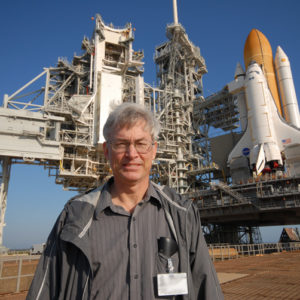
Ken Kremer and Jean Wright of Space UpClose at arrival of NASA Nancy Grace Roman Space Telescope on NASA’s Pegasus barge on Father’s Day, June 21, 2026 at NASA’s Kennedy Space Center. Roman is NASAs next great space observatory! Credit: Ken Kremer/SpaceUpClose.com
Alongside Roman, the Pegasus barge also carried a weather cover for the Artemis III SLS (Space Launch System) core stage.
NASA Nancy Grace Roman Space Telescope arrives in NASA’s Pegasus barge on Father’s Day, June 21, 2026 at NASA’s Kennedy Space Center. On the way to its Payload Hazardous Servicing Facility (PHSF) processing facility to prepare for launch NET Aug 30, 2026 on SpaceX Falcon Heavy rocket from pad 39A KSC. Roman is NASAs next great space observatory! Credit: Jean Wright/SpaceUpClose.com
The cover will protect the stage thermal systems while it sits at Launch Pad 39B in its short stack configuration. Because schedules aligned, the barge was able to transport NASA’s next flagship astrophysics mission together with the Artemis hardware, maximizing resources to support missions across the agency during the Golden Age of innovation and exploration.
Ken Kremer and Jean Wright of Space UpClose at arrival of NASA Nancy Grace Roman Space Telescope on NASA’s Pegasus barge on Father’s Day, June 21, 2026 at NASA’s Kennedy Space Center. Roman is NASAs next great space observatory! Credit: Ken Kremer/SpaceUpClose.com
Ken Kremer and Jean Wright of Space UpClose – at the NASA KSC Countdown Clock for arrival of NASA Nancy Grace Roman Space Telescope on NASA’s Pegasus barge on Father’s Day, June 21, 2026 at NASA’s Kennedy Space Center. Roman is NASAs next great space observatory! Credit: Ken Kremer/SpaceUpClose.comKen Kremer and Jean Wright of Space UpClose at arrival of NASA Nancy Grace Roman Space Telescope on NASA’s Pegasus barge on Father’s Day, June 21, 2026 at NASA’s Kennedy Space Center. Roman is NASAs next great space observatory! Credit: Ken Kremer/SpaceUpClose.com
x
Ken Kremer and Jean Wright of Space UpClose at arrival of NASA Nancy Grace Roman Space Telescope on NASA’s Pegasus barge on Father’s Day, June 21, 2026 at NASA’s Kennedy Space Center. Roman is NASAs next great space observatory! Credit: Ken Kremer/SpaceUpClose.comNASA Nancy Grace Roman Space Telescope emerges from NASA’s Pegasus barge and passes the Vehicle Assembly Building (VAB) at about 715 p.m. ET on Father’s Day, June 21, 2026 at NASA’s Kennedy Space Center. On the way to its Payload Hazardous Servicing Facility (PHSF) processing facility to prepare for launch NET Aug 30, 2026 on SpaceX Falcon Heavy rocket from pad 39A KSC. Roman is NASAs next great space observatory! Credit: Ken Kremer/SpaceUpClose.comRoman Observatory patch. NASANASA Nancy Grace Roman Space Telescope arrives in NASA’s Pegasus barge on Father’s Day, June 21, 2026 at NASA’s Kennedy Space Center. On the way to its Payload Hazardous Servicing Facility (PHSF) processing facility to prepare for launch NET Aug 30, 2026 on SpaceX Falcon Heavy rocket from pad 39A KSC. Roman is NASAs next great space observatory! Credit: Jean Wright/SpaceUpClose.comRoman Observatory logo on KSC Countdown Clock. Credit: Jean Wright/SpaceUpClose.comRoman Observatory logo. Credit: Jean Wright/SpaceUpClose.comRoman Observatory logo. Credit: Jean Wright/SpaceUpClose.com
Watch for Ken’s continuing onsite coverage of NASA, SpaceX, ULA, Boeing, Lockheed Martin, Northrop Grumman and more space and mission reports direct from Kennedy Space Center and Cape Canaveral Air Force Station in Florida and Wallops Flight Facility in Virginia. Stay tuned here for Ken's continuing Earth and Planetary science and human spaceflight news. Dr. Kremer is a research scientist and journalist based in the KSC area, active in outreach and interviewed regularly on TV and radio about space topics. Ken’s photos are for sale and he is available for lectures and outreach events.
TITUSVILLE, FL – On Aug. 7, I was interviewed live on FOX 35 Orlando about significant progress made toward stabilizing the commercial robotic LINK mission aiming to save NASA Swift space telescope from demise – via reboost to higher orbit LINK had suffered a setback post-launch when it started rotating significantly during the commissioning phase in late July The rotation
TITUSVILLE, FL – On August 5, I was interviewed live on LIVE NOW from Fox about the imminent SpaceX Falcon 9 upper stage rocket crash into the Moon just about 2 hours hour away at about 2:35 a.m. ET – that’s on a collision course crashing into the Moon at 5400 mph! Also: Why its great for science! The impact will