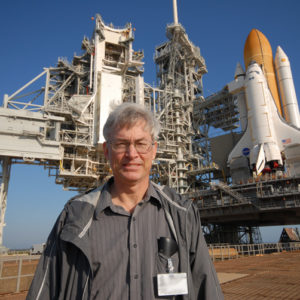


KENNEDY SPACE CENTER, FL – NASA completed a fully successful cryogenic fueling test and simulated launch countdown test of its SLS (Space Launch System) mega moon rocket during the 2nd attempt at a wet dress rehearsal (WDR) on Thursday, Feb. 19 at the agency’s Kennedy Space Center in Florida.
“Engineers loaded more than 700,000 gallons of liquid propellant into the rocket, sent a closeout crew to the launch pad to demonstrate closing the Orion spacecraft’s hatches, and completed two runs of terminal count — the final phase of the launch countdown,” NASA confirmed.
Ken Kremer of Space UpClose witnessed the crucial test at the Kennedy Space Center Press Site through the completion of both runs on the terminal countdown with a planned recycle down to the T Minus 29 second point – where it was exactly halted as planned before the core stage engine ignition.
The 2nd T Minus 29 second point was achieved and completed at around 1016 p.m. the evening of Feb 19
Ken also saw the Orion closeout crew vehicles after they departed pad 39B as they were driving towards around 6 pm Feb 19 and passing the VAB – as they would on a launch day.
Enjoy our photos for Space UpClose.
I was interviewed by CBS 6 News Orlando about the WDR 2 test – featuring my comments and rocket photos:
No significant leaks of gaseous hydrogen were observed and the countdown was not paused to limit hydrogen escape.
Furthermore, the WDR 2 test was completed withing the proscribed 2-hour launch window!
Thus, the launch team could have launched the Artemis II rocket if this had been a planned launch day – which it was not.
The Artemis II crew also observed part of the test from the Launch Control Center at NASA Kennedy.
NASA says the crew will now enter the 14 day quarantine period
During the test, teams closely monitored liquid hydrogen fueling operations, which proved challenging during the previous WDR 1 and confidence tests for Artemis II at pad 39B.
After WDR 1 ground teams installed new seals in a TSMU interface used to route liauid hydrogen (LH2) fuel to the rocket.
Hydrogen gas concentrations remained under allowable limits as noted on the NASA TV feed during the feed – thus “giving engineers confidence”
Excess gaseous Hydrogen leaking above allowable concentration limits (16%) is extremely dangerous and flammable and could result in a fire and violent explosion.
The Feb. 2 WDR test was terminated early when the hydrogen gas level reached 16% at the T Minus 5 minute point in the terminal countdown
NASA’s Artemis II mega moon rocket will launch the first humans to the Moon in over 40 years since Apollo 17 back in Dec. 1972.
Pad teams will now work to install plartforms at pad 39B to enable access to the flight termination system so that NASA can complete end-to-end testing of the safety system at the pad without have to roolback to the VAB – a lesson learned from the Artemis 1 campaign
More from NASA:
Early in fueling operations, teams experienced a loss of ground communications in the Launch Control Center. Operators temporarily moved to backup communication methods to maintain safe propellant loading activities before normal communications channels were restored. Engineers isolated the equipment that caused the issue.
A rundown of wet dress rehearsal operations is available on the Artemis blog.
While engineers review data from the test, the Artemis II crew is preparing to enter quarantine late Friday, Feb. 20, in Houston. Although NASA has not set a formal launch date, beginning the roughly 14-day quarantine to limit the crew’s exposure to illness before launch preserves flexibility in the March launch window.
NASA will discuss the wet dress rehearsal during a news conference at 11 a.m. EST Friday on the agency’s YouTube channel.
Over the next several days, technicians will use cranes to set up temporary access platforms on the mobile launcher. The platforms will allow them to reach the upper left and right segments of the SLS solid rocket boosters and core stage intertank to service the flight termination system and retest it to meet Eastern Range safety requirements. The platforms were developed based on lessons learned during Artemis I and enable NASA to complete end-to-end testing of the safety system while at the launch pad rather than rolling back to the Vehicle Assembly Building at NASA Kennedy for retesting.
The closeout crew also will practice closeout operations once more, adding to the team’s proficiency.
…..
Ken Kremer recent TV interviews:
Feb 19 WKMG CBS News Orlando: https://www.clickorlando.com/news/space-news/2026/02/18/nasa-astronauts-watch-on-as-crucial-artemis-ii-testing-wraps-up/
Feb 20 WESH 2 NBC Orlando
https://www.wesh.com/article/artemis-ii-second-wet-dress-rehearsal-underway/70420886
x