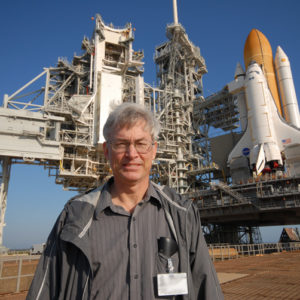


TITUSVILLE, FL – On Aug. 7, I was interviewed live on FOX 35 Orlando about significant progress made toward stabilizing the commercial robotic LINK mission aiming to save NASA Swift space telescope from demise – via reboost to higher orbit
LINK had suffered a setback post-launch when it started rotating significantly during the commissioning phase in late July
The rotation rate had reached a multi-axis rotation of 9 degrees per second with intermittent communications
As of Aug. 6 that rotation rate was reduced to 1.47 degrees per second using the ion thrusters
The spacecraft team from builder Katalyst plans to update the software
Watch my complete live interview on Fox 35 Orlando on August 7, 2026 – here including on YouTube:
Complete video: https://www.fox35orlando.com/video/fmc-2drl81g3plwmywb3
Complete video on YouTube: https://www.youtube.com/watch?v=t4OE8azIxz8
Caption: Mission Saved? Swift Observatory boost mission faces setbacks. Engineers have successfully slowed the spinning of the LINK satellite to just one degree per second following a late July anomaly that caused it to tumble across multiple axes. Ken Kremer, Managing Editor for Space UpClose, joined FOX 35’s Garrett Wymer live over Zoom to break down the latest – on Aug. 7, 2026. Credit: Fox 35 Orlando
Watch my prior interviews of WESH 2 NBC Orlando and Fox 35 Orlando here:
Latest NASA Update Aug 6, 2026
Teams are preparing to take the next major recovery steps for Katalyst Space’s robotic spacecraft LINK in orbit. During the last week, they’ve successfully reduced the spin of LINK, which is designed to boost NASA’s Neil Gehrels Swift Observatory to a higher orbital altitude.
LINK originally was in a multi-axis spin rotating at about 9 degrees per second, which resulted in sporadic communications and impeded LINK’s progress toward Swift. Using a series of burns from one of LINK’s electric propulsion thrusters, the Katalyst team now has slowed that spin to about 1.47 degrees per second. Katalyst plans to keep LINK at that spin rate as it proceeds with next steps for the mission. This includes uploading a flight software update in the coming days with new attitude controllers designed to maintain LINK’s stability in its current configuration. These updates would allow LINK to begin maneuvering to align with Swift’s orbit.
…..
LINK Reboost is High Risk, High Reward and High Excitement!!! – all rolled into one bold and historic mission – that began only 9 months ago when NASA awarded a $30 million contract to Katalyst Space in September 2025
NASAs Swift space telescope is in desperate need of reboost since its falling to Earth.
It was not designed for capture, reboost or refueling. So this is all experimental
NASA’s rescue plan involves using a new robotic spacecraft named LINK – that was air launched on a Pegasus rocket – that will grapple the probe and rescue it by raising its orbit as soon as possible which is decaying due to atmospheric drag
x