


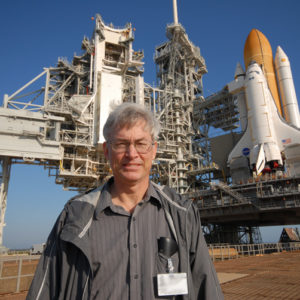
NASA KENNEDY SPACE CENTER, FL- Less than 24 hours before liftoff of NASA groundbreaking new space telescope, namely the Nancy Grace Roman Space Telescope, we media had the fantastic opportunity for an upclose visit to Launch Complex-39A at NASA’s Kennedy Space Center to set up our remote caneras and hopefully capture great images of the liftoff on the SpaceX Falcon Heavy rocket
Roman is NASAs next powerful space observatory – following in the footsteps of Hubble, Chandra, Swift, JWST and more.
NASA and SpaceX are targeting a 7:26 a.m. ET liftoff on Sunday, Aug. 30 from Launch Complex 39A on NASAs Kennedy Space Center.
Weather is only 50% GO at this time.
Backup window available on Aug. 31 with a 70% chance of GO
The Roman Space Telescope offers wide field look at the universe in search of dark energy and dark matter and hunting exoplanets beyond our solar system in infrared light – complementing JWST, the James Webb Space Telescope
The powerful Falcon Heavy will propel the observatory requiring a powerful rocket to send it more than a million miles from Earth to the L2 Lagrange point.
Roman will have a field of view 100 times wider then Hubble and will gather data 1000 times faster
Roman will gather about 1.4 terabytes of data daily
Roman is named after NASA’s first chief astronomer – Nancy Grace Roman
The next generation Nancy Grace Roman Space Telescope has been encapsulated in its nose cone and bolted atop the SpaceX Falcon Heavy
The integrated NASA Nancy Grace Roman Space Telescope and Falcon Heavy rocket stack were rolled out horizontally overnight early Saturday morning starting around 4 a.m. ET from the hanger and up the ramp at pad 39A.
After arriving atop the pad, technicians raised the almost 230-foot rocket vertical into launch position.
Enjoy our photos taken all around pad 39A and LZ-40 by Ken Kremer and more by Jean Wright for Space UpClose to capture the pre-launch, launch and landings
The Falcon Heavy has 27 Merlin engines split evenly between the center core and two side boosters that can generate more than five million pounds of thrust.
Roman is 42 feet long roughly the size of a school bus and weighs about as much at about 18,000 pounds.
It is also about the size and weight of a T Rex dinosaur!
Roman is equipped with 2 instruments, namely the WFI or Wide Field Instrument the the Coronograph, a technology demonstration that seeks out exoplanets
NASA/Sydney Rohde (Rocz)
Roman will travel to the Sun-Earth Lagrange point 2, or L2, about one million miles from Earth, where the Sun’s and Earth’s gravity balance out.
Orbiting at L2 will give the telescope a stable, unobstructed view of the universe and keep it far enough away so that Earth won’t block much of its view. From this vantage point, Roman will help answer questions about dark matter, dark energy, and exoplanets.
Roman’s wide field of view and rapid survey capabilities will map billions of galaxies, discover new exoplanets, study black holes, and provide vast volumes of daily data for astronomers to analyze. The observatory will sample such a large volume of the cosmos that the mission will offer practically limitless opportunities for astronomers to conduct a broad range of additional science.
NASA’s newest space observatory, the next generation Nancy Grace Roman Space Telescope arrived on Fathers Day, June 21, at the Turn Basin wharf at NASA’s Kennedy Space Center in Florida, cocooned safely inside NASA’s Pegasus barge.
Ken Kremer and Jean Wright of Space UpClose were on hand as members of the media invited by NASA to view the thrilling arrival events
Coverage of the 9 a.m. EDT science briefing on Aug 29 will be streamed through a variety of platforms. Learn where to watch online: https://www.nasa.gov/live.
NASA will host several news conferences this morning to discuss the Roman mission.
- Shawn Domagal-Goldman, director, Astrophysics Division, NASA Headquarters
- Julie McEnery, Roman telescope senior project scientist, NASA’s Goddard Space Flight Center
- Vanessa Bailey, Roman Coronagraph Instrument scientist, NASA’s Jet Propulsion Laboratory
- Kristen McQuinn, Roman Science Operations Center lead, Space Telescope Science Institute
- Lee Armus, science lead, Roman Science Support Center lead, Caltech/IPAC
Following the science briefing, the agency will host a prelaunch news conference at 10:30 a.m., streamed on https://www.nasa.gov/live with the following participants:
- Nicky Fox, associate administrator, Science Mission Directorate, NASA Headquarters
- Lucas Paganini, Roman telescope program executive, NASA Headquarters
- Jackie Townsend, Roman telescope project manager, NASA Goddard
- Denton Gibson, launch director, NASA’s Launch Services Program, NASA Kennedy
- Julianna Scheiman, director, NASA Science and Dragon Programs, SpaceX
- Justin McReynolds, launch weather officer, 45th Weather Squadron, U.S. Space Force
Ken Kremer recent TV interviews:
Fox 35 Orlando
https://youtu.be/b8Qzw-br9w4?si=bH7j51KUkaPXVGEE
FOX 35’s Matt Trezza reports on NASA’s latest telescope launch! Includes post launch interview on Aug. 30, 2026 with Dr. Ken Kremer, scientist and space journalist with Space UpClose
WFTV ABC News Orlando
Jul 10/11 /12 WFTV ABC News Orlando: features my comments about the scientific power of NASAs Nancy Grace Roman Space Telescope – now going final inspections and functional testing for launch NET Aug 30 on spacex falcon heavy.
story/video: https://www.wftv.com/news/local/nasas-roman-space-telescope-prepares-launch/JKPPBIDNXFGIJHLS62A3NPYLXE/
https://www.yahoo.com/news/science/articles/nasa-roman-space-telescope-prepares-011248668.html
https://www.msn.com/en-us/science/astronomy/nasa-s-roman-space-telescope-prepares-for-launch/ar-AA27Ff5G?ocid=BingNewsVerp
x


One thought on “NASAs Groundbreaking Roman Space Telescope Poised for Liftoff on SpaceX Falcon Heavy on Aug. 30: Pad 39A Photos”