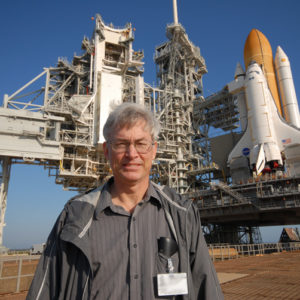


NASA KENNEDY SPACE CENTER PRESS SITE, FL- NASA and SpaceX successfully launched the agency’s cutting edge new dark universe seeking space telescope, namely the Nancy Grace Roman Space Telescope, as we watched on a sunny Sunday sunrise Aug. 30, on site at NASA’s Kennedy Space Center Press Site on the Florida Space Coast.
Roman is has now begun a three-month, million-mile journey to its final orbit, at the L2 Lagrange point – after launching some 8 months ahead of schedule!
Despite a gloomy weather forecast of only 50% GO, the skies miraculously cleared overnight and NASA’s Nancy Grace Roman Space Telescope blasted off atop a SpaceX Falcon Heavy rocket right on time at 7:26 a.m. ET liftoff on Sunday, Aug. 30 from Launch Complex 39A on NASAs Kennedy Space Center, in Florida.
The powerful Falcon Heavy propelled the ground breaking observatory on a voyage nearly a million miles from Earth to its final home where it will reside in a halo orbit at L2 Lagrange point – a gradationally stable region requiring minimal fuel usage.
The two Falcon Heavy side boosters successfully landed some eight and a half minutes later at LZ-40 and LZ-2 on Cape Canaveral Space Force Station – to screaming sonic booms many dozens of miles away from the space coast
Roman is NASAs next powerful space observatory – following in the footsteps of Hubble, Chandra, Swift, JWST and more.
“Roman pairs a large field of view with crisp infrared vision to explore vast swaths of the sky and probe deeply into cosmic history,” says NASA.
NASA’s flagship mission will help astronomers explore dark matter, dark energy, and worlds outside of our solar system, known as exoplanets. Its surveys will support a broad range of research extending far beyond the mission’s main science goals.
“Roman is exactly the kind of success story we want to see across NASA,” said NASA Administrator Jared Isaacman.
“Delivered ahead of schedule and on budget, this mission reflects more than a decade of dedication from the NASA workforce and our industry partners. Now, Roman will give us a new atlas of the universe, push the boundaries of discovery, and demonstrate what is possible when America’s space program pairs bold ambition with disciplined execution.”
Roman will have a field of view 100 times wider then Hubble and will gather data 1000 times faster
Roman will gather about 1.4 terabytes of data daily, the highest data rate of any NASA astrophysics mission, so far.
“Machine learning, artificial intelligence, and citizen scientists will help sift through it and flag significant findings, which astronomers can then study,” says NASA.
Roman is named after NASA’s first chief astronomer and first female executive – Nancy Grace Roman
She advocated for space telescopes early on at NASA and is also referred to as the “Mother of Hubble”
The integrated NASA Nancy Grace Roman Space Telescope and Falcon Heavy rocket stack were rolled out horizontally overnight early Saturday morning starting around 4 a.m. ET from the hanger and up the ramp at pad 39A.
After arriving atop the pad, technicians raised the almost 230-foot rocket vertical into launch position.
Enjoy our photos taken all around pad 39A and LZ-40 by Ken Kremer and more by Jean Wright for Space UpClose to capture the prelaunch, launch and landings
The Falcon Heavy has 27 Merlin engines split evenly between the center core and two side boosters that can generate more than five million pounds of thrust.
Roman is 42 feet long roughly the size of a school bus and weighs about as much at about 18,000 pounds.
It is also about the size and weight of a T Rex dinosaur!
Roman is equipped with 2 instruments, namely the WFI or Wide Field Instrument 300 megapixel camera detector and the Coronograph, a technology demonstration that seeks out exoplanets
The coronograph is about the size of a lunch platter and weighs about 400 pounds
Currently about 6300 exoplanets are known
Roman is expected to discover over 100,000 exoplanets perhaps within the first year of the observatories mission
Roman will travel to the Sun-Earth Lagrange point 2, or L2, about one million miles from Earth, where the Sun’s and Earth’s gravity balance out.
Orbiting at L2 will give the telescope a stable, unobstructed view of the universe and keep it far enough away so that Earth won’t block much of its view. From this vantage point, Roman will help answer questions about dark matter, dark energy, and exoplanets.
Roman’s wide field of view and rapid survey capabilities will map billions of galaxies, discover new exoplanets, study black holes, and provide vast volumes of daily data for astronomers to analyze. The observatory will sample such a large volume of the cosmos that the mission will offer practically limitless opportunities for astronomers to conduct a broad range of additional science.
More from NASA:
During launch and early orbit, Roman uses the Near Space Network’s ground stations and relay satellites to exchange tracking, telemetry, and command data with ground controllers. About 70 minutes after launch, the Deep Space Network takes over communications and guides Roman toward the second Sun-Earth Lagrange point, or L2, about one million miles from Earth. Roman connects to that network through the Canberra Deep Space Communication Complex in Australia first. Approximately six hours later it will transfer to the Madrid Deep Space Communication Complex in Spain and then to the Goldstone Deep Space Communication Complex in California, ensuring continuous contact with Roman throughout its journey.
The Roman team also confirmed successful deployment of the observatory’s solar panels and lower instrument sun shade an hour and 23 minutes after launch. Within the upcoming days, Roman’s high-gain antenna and visor-like deployable aperture cover will deploy, ground controllers will initiate the first of two-mid-course corrections, and the Coronagraph Instrument will power on. This instrument will demonstrate the technology that future missions like NASA’s Habitable Worlds Observatory concept could use to image Earth-like planets in the search for life in the universe. Roman’s Coronagraph will take a giant step in that direction by snapping pictures of Jupiter-like planets.
A few weeks into Roman’s voyage, its primary instrument, the Wide Field Instrument, will activate. This 300-megapixel infrared camera has 18 4K detectors, each about the size of a saltine cracker. These detectors collect photons of light that will be decoded into crisp cosmic panoramas. Thanks to the observatory’s rigid design and stable optical performance, it will rapidly scan the sky without needing substantial time between separate observations. The Roman telescope is designed to survey the universe a thousand times faster than NASA’s Hubble Space Telescope.
Throughout the rest of Roman’s three-month commissioning period, scientists will run the instruments through a series of calibrations and tests. NASA anticipates releasing Roman’s first images by early 2027.
Roman will send back 1.4 terabytes of data every day, the highest data rate of any NASA astrophysics mission, so far. Machine learning, artificial intelligence, and citizen scientists will help sift through it and flag significant findings, which astronomers can then study.
“We’ve never been able to view the universe with eyes like Roman’s before,” said Julie McEnery, Roman’s senior project scientist at NASA Goddard. “There’s no telling what more we’ll know and have seen by this time next year.”
Roman is the fourth primary mission NASA has launched on a Falcon Heavy rocket. Earlier this year, the agency’s Launch Services Program worked with SpaceX to accelerate the launch date to accommodate the space telescope’s early completion.
The telescope is managed at NASA Goddard with participation by the agency’s Jet Propulsion Laboratory in Southern California; Caltech/IPAC in Pasadena, California; the Space Telescope Science Institute in Baltimore; and a team of scientists from various research institutions. The primary industrial partners are BAE Systems Inc., L3Harris Technologies, and Teledyne Scientific & Imaging. Contributions to Roman also are made by ESA, JAXA, the French space agency CNES (Centre National d’Études Spatiales), and the Max Planck Institute for Astronomy in Germany.
…………………
NASA’s newest space observatory, the next generation Nancy Grace Roman Space Telescope arrived on Fathers Day, June 21, at the Turn Basin wharf at NASA’s Kennedy Space Center in Florida, cocooned safely inside NASA’s Pegasus barge.
Ken Kremer and Jean Wright of Space UpClose were on hand as members of the media invited by NASA to view the thrilling arrival and launch events
…….
Ken Kremer recent TV interviews:
Fox 35 Orlando
https://youtu.be/b8Qzw-br9w4?si=bH7j51KUkaPXVGEE
FOX 35’s Matt Trezza reports on NASA’s latest telescope launch! Includes post launch interview on Aug. 30, 2026 with Dr. Ken Kremer, scientist and space journalist with Space UpClose
WFTV ABC News Orlando
Jul 10/11 /12 WFTV ABC News Orlando: features my comments about the scientific power of NASAs Nancy Grace Roman Space Telescope – now going final inspections and functional testing for launch NET Aug 30 on spacex falcon heavy.
story/video: https://www.wftv.com/news/local/nasas-roman-space-telescope-prepares-launch/JKPPBIDNXFGIJHLS62A3NPYLXE/
https://www.yahoo.com/news/science/articles/nasa-roman-space-telescope-prepares-011248668.html
x